


How RF Admittance Level Sensors Accurately Measure Liquid Levels?
RF Admittance Level Sensors operate based on admittance measurement technology, which measures liquid level by detecting the combined changes in capacitance and resistance between the sensor probe and the measured medium. Unlike traditional capacitive level sensors that measure only capacitance, RF admittance technology applies an RF signal within a specific frequency range to the probe, ensuring that each liquid level corresponds to a unique and stable electrical signal output, thus providing accurate liquid level readings.
RF Admittance Level Sensor
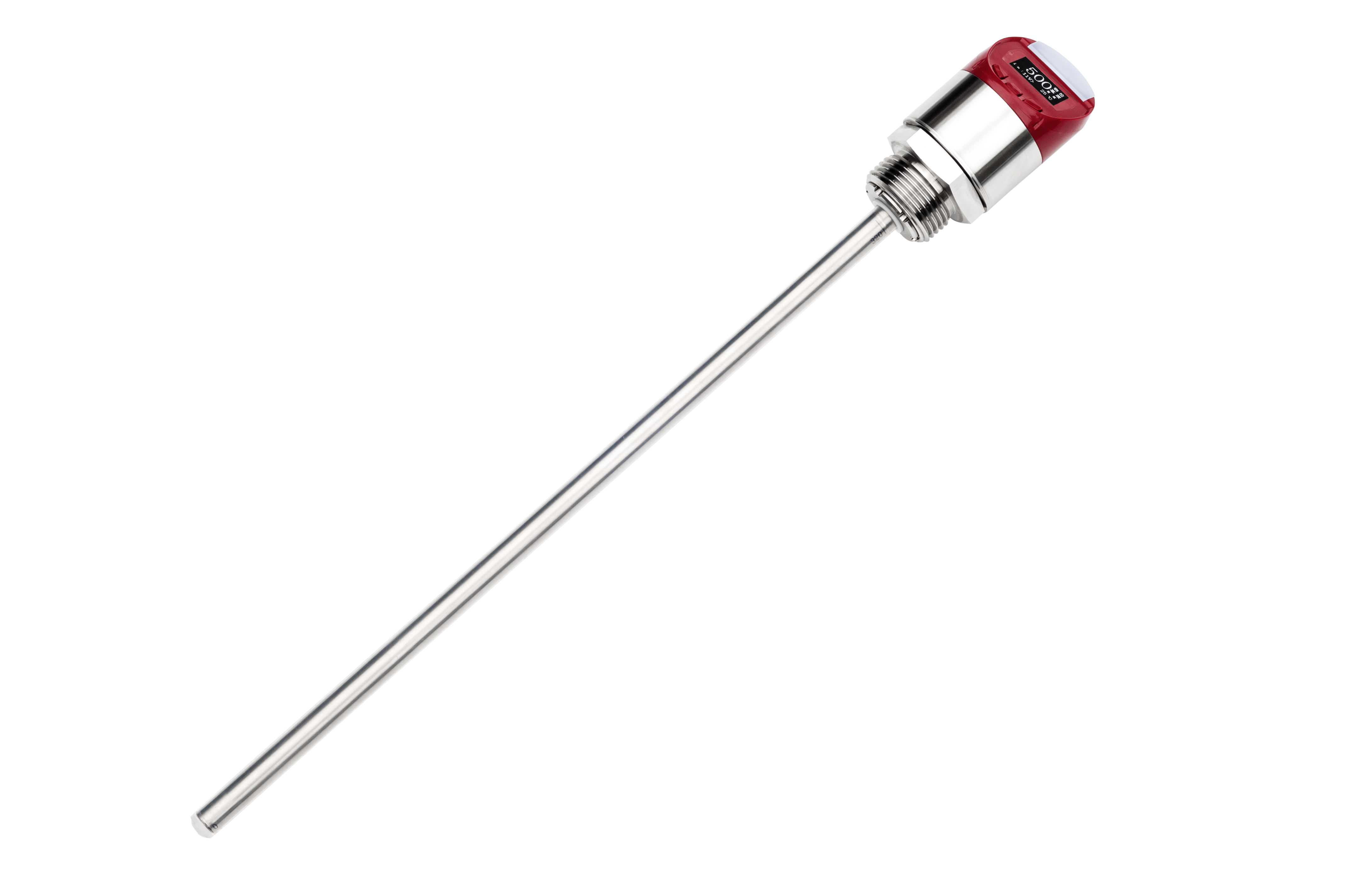
The sensor consists of a measurement probe and an electronic processing unit. The electronic unit applies a stable RF excitation signal, typically in the 15–400 kHz range, to the probe. As the liquid level changes, the electric field between the probe and the medium alters, causing simultaneous changes in capacitance and leakage resistance. The electronic circuitry analyzes these parameters to calculate the corresponding admittance, which is then converted into an electrical signal proportional to the liquid level.
During signal processing, the sensor performs detection, demodulation, and filtering of the RF signal to eliminate high-frequency interference and environmental noise. The final output can be:
Analog DC signals (0.5–4.5 V or 4–20 mA)
Digital signals (RS485 Modbus)
The output signal amplitude is linearly proportional to the liquid level, enabling continuous liquid level measurement.
RF Admittance Level Sensors require dedicated electronic circuitry for RF excitation, admittance detection, and signal conditioning. With internal filtering and digital processing, these sensors maintain stable measurement performance while offering fast dynamic response, making them suitable for real-time industrial liquid level monitoring.
Structurally, RF Admittance Level Sensors are available as either integrated probes or remote (split) probes. The probe connects via cable to the electronic processing unit, where all signal conditioning and output conversion occurs. Compared with traditional capacitive level sensors, RF admittance technology is insensitive to surface buildup, medium adhesion, and contamination, effectively eliminating errors caused by material accumulation. This ensures stable and reliable performance even under high temperature, high pressure, or highly viscous conditions.


